- LineStar Weekly Pitstop (NASCAR)
- Posts
- LineStar® Weekly Pitstop - Straight Talk Wireless 500

LineStar® Weekly Pitstop - Straight Talk Wireless 500
🔥Written by 2020,2023 FBWC, 2021 KoS, 2023(x3) and 2024 FWRC qualifier @joejets19
💬Join the LineStar NASCAR Chat for info from experts.
Check out the Straight Talk Wireless 500 Cheatsheet
Straight Talk Wireless 500🏁
History was made last weekend at COTA when Tyler Reddick won his third straight race to start the season. Can he make it four in a row? We will find out this Sunday when the NASCAR Cup Series travels to Phoenix Raceway in Avondale, AZ, for the Straight Talk Wireless 500. The track is a flat, 1-mile, dogleg oval known for its wide apron, which allows drivers to race 5 and 6 wide if they choose to. Track history could be a bit misleading at Phoenix because it hosted the Championship race the last six seasons, and some drivers were happy to just eat laps and start their break a week early. Drivers that finish well at correlated tracks do tend to finish well at Phoenix, so that may be the stat we should focus on for this slate. One thing that cracks me up every season is that the race is only 312 laps long on a one-mile track, where do they get the 500 from? Make sure to keep reading to find the answer.
Avondale, like Phoenix, is in a desert, so expect this race to be hot, with a zero percent chance of rain. Oddly, while there is some precipitation in the forecast for Monday, this race should go off without a hitch (weather-wise).

Scoring Breakdown
At this point, we know how the DK scoring system works, so let's see how many points are available this week:
Laps Led Points =0.25 points per lap led. 312 laps will be run this week, and 78 DK points will be awarded (plus any overtime laps).
Place Differential Points = 1 point per position gained or -1 point per position lost.
Fastest Lap Points = 0.45 points per lap not run under caution (roughly 277 laps should run under the green flag for 124.65 possible DK points)
Finishing Position Points: The 40th-place driver receives 4 points, and for each position gained, another point is awarded (39th=5, 38th=6…), and the winner gets 46 points.
Lineup Construction 🏗

1) Dominators are back. 312 laps (aka 500 kms) at a short track offers the most dominator points we have had this season. A driver starting in the front row has made the perfect lineup in each of the last eight races at Phoenix. There is generally at least a second minor dominator, and they will also start in the top 10.
2) Front-loaded lineups may be the way to go on Sunday. The championship races skew the stats a touch, but with the exception of last Spring in three of the last four non-championship races here, only one driver starting worse than 26th made the perfect lineup. 1 front-row driver, 1 other top 10 driver, 2 drivers starting 11-20, and 2 drivers starting 21-29 have been a fairly successful recipe at Phoenix in the Next Gen Era.
3) The Championship tires are back. NASCAR has been focused on making short-track racing better this season, and part of that change is running a tire with more fall-off. The Cup Series cars will run the same exact tire that they ran in the Champion Race, which could point to more attrition than we are used to at a typical Phoenix race.
4) High-risk basement drivers are the target in tournaments. Cheap drivers starting in the rear aren’t going to pull off a miracle on Sunday. A more likely route to the perfect lineup is a low-priced driver who qualified well and stayed up front.
Stage 1: 60 Laps
Stage 2: 125 Laps
Stage 3: 127 Laps
Lineup Foundation Targets

Key: L5= Avg Fin here since 2022 , L5 PD= Avg Place Diff here since 2022, Corr= correlated track average finish 2024, Corr PD= correlated track average PD 2024, P1= practice 1 single lap rank, 10 lap= practice 1 10 lap average rank, Start = Starting Pos, Run= avg run position here since 2022, Corr Run= correlated track avg run position 2024, Proj Fin Pos= machine learning model predicted finishing position, Avg Sim Fin= avg finishing position over 100 simulated races, Ceiling- best finishing position over 100 simulated races, Floor= worst finishing position over 100 simulated races, Top 10%= number of times the driver finished in the top 10 over 100 simulated races.
Chase Elliott ($9,000 DK, $10,500 FD): There are a ton of midrange options to choose from this weekend, but my top pick is Chase Elliott. He starts 26th on Sunday and struggled in practice, but my model doesn’t seem to worry about that too much, giving him a 98% chance of finishing in the top 10, a feat he has accomplished in each of his last three races here. While this is easily the worst starting position Elliott has had in his last seven Phoenix races, all I am hearing is place differential
Brad Keselowski ($8,300 DK, $7,200 FD): Speaking of place differential, you can’t get any more Brad Keselowski than from his last-place starting position. Kes was not able to qualify after crashing in practice and will now have to use a backup car on Sunday. While his price and ownership are both higher than I would like, he is still cheap and should be a lock for cash games.
Kyle Busch ($8,000 DK, $6,500 FD): For a driver who hasn’t won since 2023, I seem to be gravitating toward Busch a lot so far this season. He starts 29th on Sunday, but he showed some speed in his car during the short practice run. Kyle can finish well at Phoenix, with two top 10 finishes in his last two races here, but he doesn’t usually move around much, so his good finishes come from good qualifying runs. That little nugget may suggest that we should go underweight on Busch in tournaments.
Tournament Targets

Key: L5= Avg Fin here since 2022 , L5 PD= Avg Place Diff here since 2022, Corr= correlated track average finish 2024, Corr PD= correlated track average PD 2024, P1= practice 1 single lap rank, 10 lap= practice 1 10 lap average rank, Start = Starting Pos, Run= avg run position here since 2022, Corr Run= correlated track avg run position 2024, Proj Fin Pos= machine learning model predicted finishing position, Avg Sim Fin= avg finishing position over 100 simulated races, Ceiling- best finishing position over 100 simulated races, Floor= worst finishing position over 100 simulated races, Top 10%= number of times the driver finished in the top 10 over 100 simulated races.
Joey Logano ($9,200 DK, $11,000 FD): Logano starts on the pole on Sunday, and one thing he continually proves is that he can turn his car into a boat when he starts up front at a short track. Joey wasn’t overly impressive in practice on Saturday, but he was faster than Larson, and that is his stiffest competition during the early portion of the race. Logano has won two of the last three races where he started on the front row, and he still made the perfect lineup in the one race her didn’t win.
Chris Buescher ($8,500 DK, $8,500 FD): Buescher has finished in the top 10 in four of his last five races at Phoenix and starts 17th on Sunday. Chris was exceptionally fast over the long run in practice, posting the 6th-best 10- and 15-lap averages. While everyone is looking towards the rear of the field in the mid-range, Buescher offers a fantastic tournament pivot.
Ross Chastain ($8,800 DK, $9,500 FD): Ross Chastain starts 6th on Sunday, and it looks like he brought a rocket ship to Phoenix. Chastain ran the 4th best single lap speed on Saturday and posted top three 10, 15, 20, 25, and 30 lap averages. While the last few races here haven’t gone Ross’s way, he won in 2023 and has two other top 3 finishes since 2022.
Ryan Preece ($7,000 DK, $6,800 FD): We mentioned Keselowski, we mentioned Buescher, so we might as well complete the Jack Roush trifecta and talk about Ryan Preece. Preece excelled at short flat tracks during his tenure at short flat tracks and was able to continue his success with two top 15 finishes here last year. Preece starts 13th, so this is not a safe play by any means, but if he can pick up a couple of spots and land in the top 10, he has a decent chance at making the perfect lineup.
Bargain Basement
Noah Gragson ($5,900 DK, $4,200 FD)
Gragson starts 35th on Sunday and actually had consecutive 12th-place finishes here in 2024. While his practice times left much to be desired, his starting position and price are hard to pass up. If he can come anywhere close to the top 20, that would be a major win and give him the shot at making the perfect lineup.
Other Drivers to Consider
Here are three more drivers I like at Phoenix that have a chance to make some noise in no particular order:
Bubba Wallace ($7,200 DK, $8,000 FD)
Denny Hamlin ($11,000 DK, $12,500 FD)
Ty Gibbs ($6,400 DK, $6,200 FD)
Top Driver to Avoid
Carson Hocevar ($7,700 DK, $8,200 FD)
It is not often that a computer model projects a driver to crash, but considering Hocevar’s 37th-place projected finish from his 7th-place starting position, I don’t really know what else to call it. Carson has lost spots in four straight races at Phoenix, including consecutive finishes of 28th or worse. Everything points to Hocevar having a nice race on Sunday, but something just seems off, so I am going to avoid him.
Pitstop Picks
2022 results: 17-57 (-27.3 u) 2023 results: 15-50 (-25.65 u)
2024 results: 28-40 (2.2 u) 2025 results: 29-41 (6.2 u)
2026 results: 3-3 (0.8 u)

Chris Buescher +125 (1u) to have a better finishing position than Chase Briscoe
We are picking Chase Briscoe to lose another preposterously close H2H again this weekend. My model projects Buescher to finish 10th and Briscoe to finish 11th, but the race simulations give Briscoe the edge, with an average finish of 12.73 vs 12.75. I cannot remember a split that close, but I will roll with Buescher, who won this H2H in each of the last five races at Phoenix.
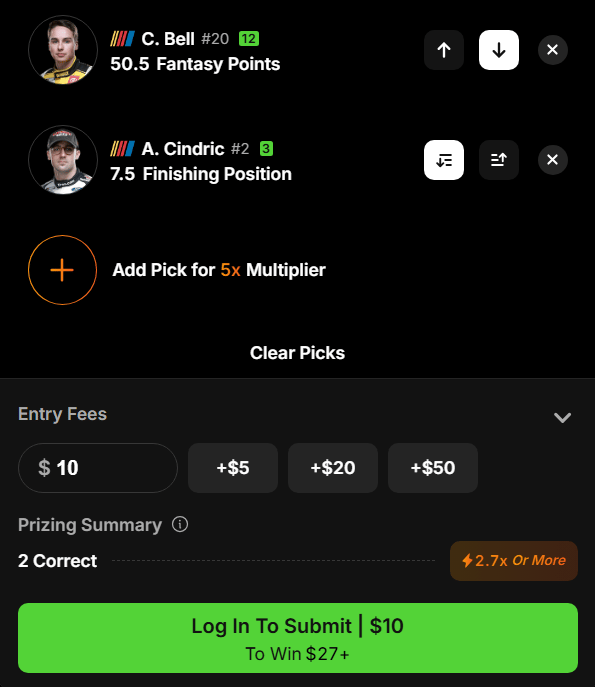
Christopher Bell to score less than 50.5 DK pts and Austin Cindric to finish worse than 7.5 (1u to win 2.7u)
Christopher Bell starts 12th on Sunday and has won each of the last two Spring Phoenix races. To win this prop, Bell would have to finish in the top 3 if he doesn’t add any dominator points. My model projects Bell to finish 7th, so as long as he doesn’t pick up 8 dominator points, it will be a winner. Cindric, on the other hand, started 3rd and never finished better than 11th. There are some incredibly fast cars starting directly behind him, so I don’t expect Austin to hold on to his track position very long.
Pitstop Poll
2023 Results: 3-4 (+2.85 u) 2024 Results: 11-15 (+11.45 u)
2025 Results: 7-15 (-4.09 u)
2026 Results 2-1 (3.65 u)
I will select one of the groups posted on the DK Sportsbook and leave it up to the readers to vote on their preferred bet. I will keep track of this throughout the season to see how well we are doing. This week’s selection:
Who will have the best finishing position? |
Thanks for reading, and good luck this weekend! Be sure to join me in the LineStar NASCAR chat!
For additional stats, check out the Straight Talk Wireless 500 Cheatsheet
Find me on Twitter. Good Luck!